
The latest Nationwide House Price Index shows that annual UK house price growth slowed to just 0.8% in September, with the average UK property now valued at £274,251.
And, actually, I don’t necessarily see greater stability in house prices as a bad thing.
After the significant increases we’ve seen over recent years, prices were always going to reach a point where the national market became more stable.
Combine improving affordability with the Government’s recently announced plans to support first-time buyers, and there are reasons to believe we could see more movement within parts of the housing market.
But, as I say every month:
National headlines tell you about what is happening in the UK. Local data tells us what is happening locally in your market.
And once again, our data across Blackpool, the Fylde Coast and Preston is telling a very different story.
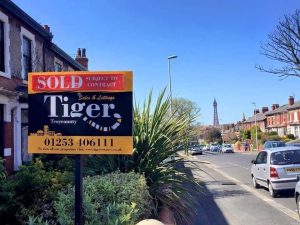
Local house prices continue to show resilience
Our transactional data continues to indicate annual house price growth in the region of 6–7% across the areas in which we operate.
At first glance, September might appear to contradict that.
The average property sold through Tiger during September was approximately £137,000, compared with £150,000 in August.
But this demonstrates precisely why average sale prices need context.
We sold a greater proportion of lower-priced properties during September, so simply comparing the headline average with August doesn’t provide a like-for-like assessment of what happened to property values.
When we compare similar properties within our own transactional data, we are seeing an underlying month-on-month increase of approximately 3% between August and September.
On a property worth around £137,000, that movement would be equivalent to approximately £4,000.
That doesn’t mean every property in Blackpool increased by £4,000 in September. Property values vary significantly by location, type, condition and price point.
But it does provide further evidence that our local market is continuing to demonstrate resilience while the national market has slowed considerably.

Buyers aren't disappearing – they are buying
Perhaps one of the most interesting figures for me this month is transaction activity.
September was Tiger’s third-highest month of 2026 so far for sales agreed.
That tells us something important about buyer behaviour.
The buyers who are currently in the market are serious.
They’re seeing property values locally continuing to demonstrate resilience and, where the right property becomes available at the right price, they’re prepared to act.
That is particularly interesting against a national backdrop where higher borrowing costs and economic uncertainty have been weighing on activity.
It also reinforces something we’ve been saying throughout the year: a quieter or more price-sensitive market does not mean there aren’t buyers.
There are.
But they are increasingly informed, selective and proactive when they see value.

Thinking of selling? This could be the opportunity
For sellers, I think September’s figures should provide some real encouragement.
Price still matters, and strong local price growth doesn’t mean that any property can be placed on the market at any price and expect to sell.
Buyers have access to more information than ever before and they will compare properties, previous sales and competing listings. The properties attracting serious interest are those where the asking price reflects the market.
But the other side of that equation is demand.
September was our third-highest month of the year for sales agreed and, right now, we have a significant number of active buyers registered with Tiger who are looking for their next property.
So, if you’ve been considering selling but waiting for the right time, I think there is a strong argument for taking advantage of the resilience we’re currently seeing in the local market.
Nobody can guarantee how long current market conditions will continue. Interest rates, the wider economy and buyer confidence can all change.
What we do know is what is happening today: we have buyers looking, properties are selling and our local data continues to show resilience in values.
My message to potential sellers is simple: don’t wait for the market to tell you that you missed the opportunity.
If you’re considering selling a property across Blackpool, the Fylde Coast or Preston, we’re more than happy to give you an honest assessment of its current value, show you what comparable properties are actually achieving and discuss the buyers we currently have looking.
Blackpool rents reach £719 per month
The rental market continues to tell an equally interesting story.
The average rent achieved during September reached approximately £719 per calendar month.
That’s an increase of around 7% year-on-year.
It is also approximately 0.6% higher than August, when the average was £714 per month.
In cash terms, that’s another £5 per month.
For an individual tenant or landlord, £5 might not sound particularly significant. But the important point is the direction of travel.
Rental values are continuing to increase despite already experiencing significant growth over recent years.
And that comes back to the fundamental issue of supply and demand.
Tenant demand remains strong while the number of available rental properties remains constrained.
Why is Blackpool proving so resilient?
This is the question I keep coming back to.
Why does Blackpool appear to be behaving differently from much of the national market?
I think there are several factors.
Firstly, affordability.
Blackpool remains one of the more affordable places to purchase property, particularly when compared with many other parts of the North West and the wider UK.
Secondly, we have a significant investor market.
Lower acquisition costs combined with strong tenant demand can continue to produce attractive rental yields, although investors obviously need to account for finance costs, maintenance, taxation and the increasingly demanding regulatory environment.
Thirdly, rental demand remains strong.
That demand continues to support rental values and makes well-located, correctly priced investment property attractive to investors.
And finally, there is the wider Blackpool story.
Regeneration continues. There are ambitions to improve employment opportunities, significant investment taking place across the town and a continued focus on addressing some of the challenges Blackpool has historically faced.
For years, we’ve talked about Blackpool as an affordable market with investment potential.
I think the cat might finally be getting out of the bag.
More investors are recognising that affordability alone isn’t the story.
It’s the combination of affordable entry prices, strong rental demand, potential returns and regeneration that makes the local market particularly interesting.

Stability nationally. Resilience locally.
September is another reminder of why property should never be viewed purely through a national lens.
Nationally, annual house price growth has slowed to 0.8%.
Locally, our own transactional evidence continues to point towards annual growth of approximately 6–7%, while comparable properties within our data suggest values continued to move upwards during September.
At the same time, September became our third-highest month of the year for sales agreed, while average rents increased to £719 per month, approximately 7% higher than a year ago.
That doesn’t mean prices will continue rising at the same rate, and no property market moves in a straight line.
But right now, the evidence we’re seeing on the ground suggests that Blackpool, the Fylde Coast and Preston continue to demonstrate considerable resilience.
For sellers, that creates an opportunity. We have active buyers looking for property now, and if you’re considering moving, there is a strong argument for making the most of the market conditions we have rather than trying to predict what comes next.
National headlines tell you about what is happening in the UK. Local data tells us what is happening locally in your market.